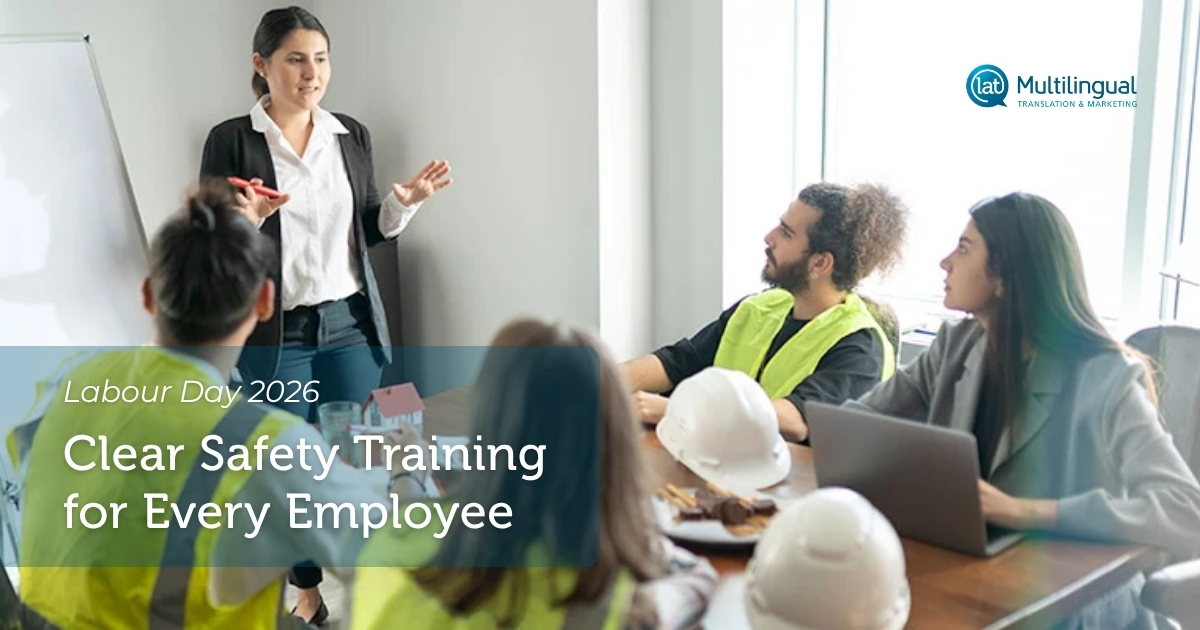
An employee watches the required safety video, signs the form and starts the shift. On paper, the training is complete.
But can the employee identify a hazardous product, stop equipment safely or respond correctly during an emergency?
When training is delivered too quickly, written in an unfamiliar language or filled with technical terms, the record may say “trained”, while the employee remains unsure what to do when something goes wrong.
As Canada marks Labour Day on September 7, it is worth asking a practical question: are workplace safety communications reaching everyone?
Canada’s Workplaces Are Multilingual
According to Statistics Canada’s 2021 Census, nearly 670,000 people, about one in 25 Canadian workers, used a language other than English or French at work. The largest numbers were in health care and social assistance, retail trade, and accommodation and food services, with Mandarin, Punjabi, Cantonese and Spanish among the most common non-official languages used.
Many of these workers also used English or French at work, but conversational ability does not necessarily equal technical comprehension. An employee may be comfortable discussing schedules and everyday tasks in English while struggling to understand chemical-handling instructions, equipment warnings or emergency procedures.
Start by Identifying Your Workforce’s Needs
Employees often learn routines by observing colleagues, which works fine until something unusual happens: a chemical spill, an equipment malfunction, an evacuation. In those moments, no one should have to guess.
Safety training, emergency procedures, hazardous-product information and incident reporting carry more risk than a staff newsletter. Employers should prioritize the information employees need to understand and act on, especially where health, safety or workplace rights are involved.
Identify where communication barriers may exist.
Consider the following questions:
- What languages do employees understand most comfortably?
- Which employees may have difficulty reading technical English or French?
- Are new employees reluctant to ask questions in group settings?
- Do supervisors repeatedly need to explain certain procedures?
- Are errors or near misses occurring because instructions were misunderstood?
- Are temporary, seasonal or recently arrived workers receiving the same level of support as other employees?
This assessment should be handled respectfully. The objective is not to test or label employees. It is to identify how safety information can be delivered more effectively.
WHMIS Makes the Point Clear
The Workplace Hazardous Materials Information System, or WHMIS, offers a clear example of why multilingual workplace safety training matters. It applies to hazardous products used, handled or stored across a wide range of workplaces, including health-care facilities, hotels, restaurants and retail operations.
In Ontario, employers must ensure, so far as reasonably practicable, that WHMIS education enables workers to use the information to protect their health and safety. Ontario’s WHMIS guide notes that language and literacy barriers may make it harder to determine what workers have learned.
This does not create a blanket rule requiring every course to be translated into every worker’s first language, and requirements vary by jurisdiction. But it reinforces a simple principle: making information available is not the same as communicating it successfully.
Review Training Regularly
Language support should be part of an ongoing safety program, not a one-time accommodation during orientation.
Review training whenever:
- New equipment or hazardous products are introduced
- Procedures change
- An employee changes roles
- An incident or near miss occurs
- Supervisors identify recurring misunderstandings
- The workforce’s language needs change
Employers should also invite employees to identify unclear instructions and suggest improvements. Workers often know exactly where communication breaks down, but they need a safe and respectful way to provide that feedback.
A Practical Employer Checklist
Before considering safety training complete, confirm that:
- High-risk information has been identified and prioritized.
- Instructions use clear, plain language.
- Appropriate translation or interpretation has been provided.
- Visuals and demonstrations support written information.
- Employees can ask questions without embarrassment or penalty.
- Understanding has been verified through explanation or demonstration.
- Additional training is provided when comprehension is uncertain.
- Materials are updated when workplace conditions change.
- Training methods and results are properly documented.
Labour Day celebrates the contributions workers make every day. Ensuring that every employee understands the information intended to protect them is one practical way to honour those contributions.
Sending the message is the easy part. Effective safety training means making sure employees can understand it, remember it and act on it when it matters most.