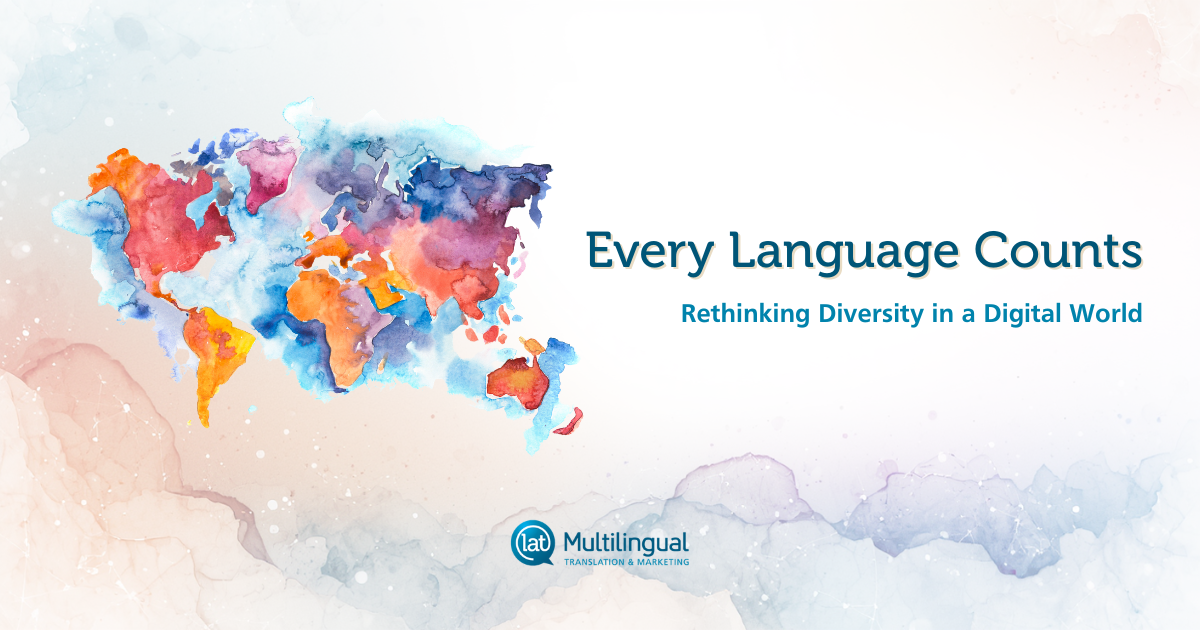
Every year on February 21, the world celebrates International Mother Language Day, an initiative launched by UNESCO and later adopted by the United Nations to emphasize the importance of linguistic diversity and the role of languages in building inclusive societies.
It is a moment to reflect on the linguistic richness of our planet, and also on the disparities that exist between languages spoken in daily life and those that dominate the digital world.
The World’s Most Spoken Languages: A Reality Check
According to data from Ethnologue, more than 1.53 billion people speak English worldwide when both native and second language speakers are included.
However, this impressive number still represents less than 20% of the world’s population, meaning that more than four in five people do not speak English.
After English, Mandarin Chinese counts approximately 1.18 billion speakers, and Hindi ranks third with about 609 million speakers.
These figures highlight how linguistically diverse the world truly is—far more than global media or digital platforms may suggest.
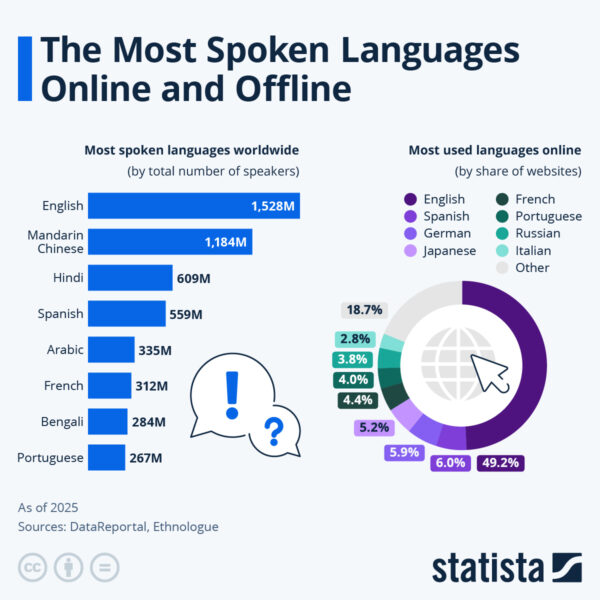
This infographic shows the most spoken languages online (by share of websites) and offline (by total number of speakers). Sources: DataReportal, Ethnologue
But Online, the Landscape Looks Very Different
Nearly half of all websites (49.2%) are in English, according to DataReportal’s Global Digital Overview.
This makes English disproportionately dominant online compared to its real-world share of speakers.
Meanwhile, languages with vast speaker populations remain severely underrepresented:
- Chinese appears on just 1% of websites, despite being spoken by more than a billion people.
- Arabic, with 335 million speakers, accounts for less than 0.5% of websites and remains significantly underrepresented online.
This contrast demonstrates a persistent imbalance between everyday language use and digital presence.
Why This Matters
International Mother Language Day encourages us to value all languages equally. Yet the current digital ecosystem continues to privilege a handful of dominant languages—mainly English—while sidelining many others.
Promoting linguistic diversity online helps:
- make information more accessible;
- support cultural preservation;
- encourage participation from communities often marginalized in digital spaces;
- and, importantly, it makes business sense—multilingual content brings more customers to your brand.
Consumers consistently trust brands that speak their language, and companies that invest in multilingual communication expand their reach, improve customer experience, and increase conversion rates in new markets.
Towards a More Inclusive Digital World
As technology continues to shape how we communicate, work, and learn, multilingualism becomes increasingly essential. Creating, translating, and localizing content in a broader range of languages ensures that the internet becomes a place where everyone—regardless of mother tongue—feels represented.
On this International Mother Language Day, it’s worth remembering: every language carries a unique worldview, and supporting linguistic diversity helps preserve the richness of our shared human experience.